
Inside Èlysèen's Human Systems Blueprinting
- Sarah Soul
- Feb 1
- 6 min read

Updated: Mar 17
A Living Map of Access, Communication, and Coherence

When we hear the word 'blueprint', typically what comes to mind is a technical drawing- an intricate set of instructions detailing how something is built, where each component belongs, and how it all fits together. Blueprints are precise, methodical, and static. Once finalized, they rarely change.
Human systems are different.
At Èlysèen, blueprinting is about revealing how a human system is actually operating in the present moment, what it can access, what it cannot, and how its internal systems are communicating right now.
Over years of working across performance, recovery, leadership, and personal transformation, a consistent pattern presents itself. Most modern models are highly sophisticated and extract great value in information to become healthier, live longer, how we think etc..We measure physiology with precision. We assess psychology and cognition. We talk fluently about mindset , resilience, readiness, optimization, and capacity.
And yet, many high performers remain unable to reliably access what they know they are capable of. We've realized this is because they often operate in parallel, rather than in communication.
Human systems are not meant to be isolated. They are designed to interact seamlessly, and continuously- neurologically, physiologically, perceptually, emotionally, and chemically. When these systems lose coherence, information exists, but access does not.
Blueprinting, as practiced inside Èlysèen, begins here.
Human Systems as a Living Communication Network
As we've talked about before, at Èlysèen we do not view the human system as fragmented, nor as a checklist of independent parts. Instead, it is understood as a living network of communication, where systems are always present, but not always accessible.
This is where hierarchy must be understood carefully.
In Èlysèen's framework, hierarchy does not imply importance or superiority. It describes order of access. Certain systems determine whether others can be utilized in a given moment. At the centre of this access architecture is the nervous system.
Modern neuroscience increasingly confirms what many practitioners observe experientially: when the nervous system detects threat- whether physical, emotional, or symbolic, access to higher-order function narrows automatically.
Strength may exist. Skill may be trained. Cognitive understanding may be intact. But expression becomes inhibited. In this work, the nervous system is understood as the primary gatekeeper of access, and this isn't stating that it is more important than other systems, but because it governs whether the system is oriented toward protection or openness, and determines what resources- cognitive, emotional, physiological- are available in any moment.
From this lens, human systems organize outward through communication:
Perceptual Systems: How the system interprets reality, meaning, risk, and possibility.
Shapes what is noticed, filtered, anticipated, or ignored. Thus informing how the world is experienced before conscious thought or action occurs.
Psychological/ Identity Systems: How meaning, self-concept, and role are organized across experience
This includes belief structures, identity narratives, internal models of self and world, and the sense of "who I am" that informs choice, effort, and expression. This system is not only activated under stress; it continuously organizes how experience is understood and integrated.
Physiological Systems: The body's capacity for energy, movement, regulation, and repair.
Represents what the system can physically support once access is permitted. This could stem across endurance, strength, recovery, immune function, and vitality.
Behavioral Expression: How internal organization manifests through action, movement, and decision-making
Reveals the current coherence (or lack thereof) between systems through consistency, adaptability, timing, and execution.
Coherence & Integration: The quality of communication and alignment across all systems
When coherence is high, effort feels efficient, expression feels natural, and capacity becomes usable. When coherence is low, systems compete rather than collaborate.
As we know, all systems are always present. The question is whether they are accessible, communicating effectively, and aligned toward a shared direction of expression.
Patterning, Trauma, and Identity- Reframed
Within the Èlysèen framework, patterning, trauma and identity are understood as intelligent nervous system strategies- adaptations that once served a protective or organizing function, and that persist when access remains gated.
So we ask how do we dissolve this protective patterning? Understanding why a pattern exists is a fundamental introduction, however the act of dissolving a pattern that no longer serves ones current phase of life, their current state, or where they are looking to go at embodied identity level happens when the system experiences safety, competence, and coherence through lived experience.
When access is restored, protective strategies often release on their own,
Blueprinting does not force change. It simply reveals what sequence of experience the system can trust.
What Blueprinting Actually Does
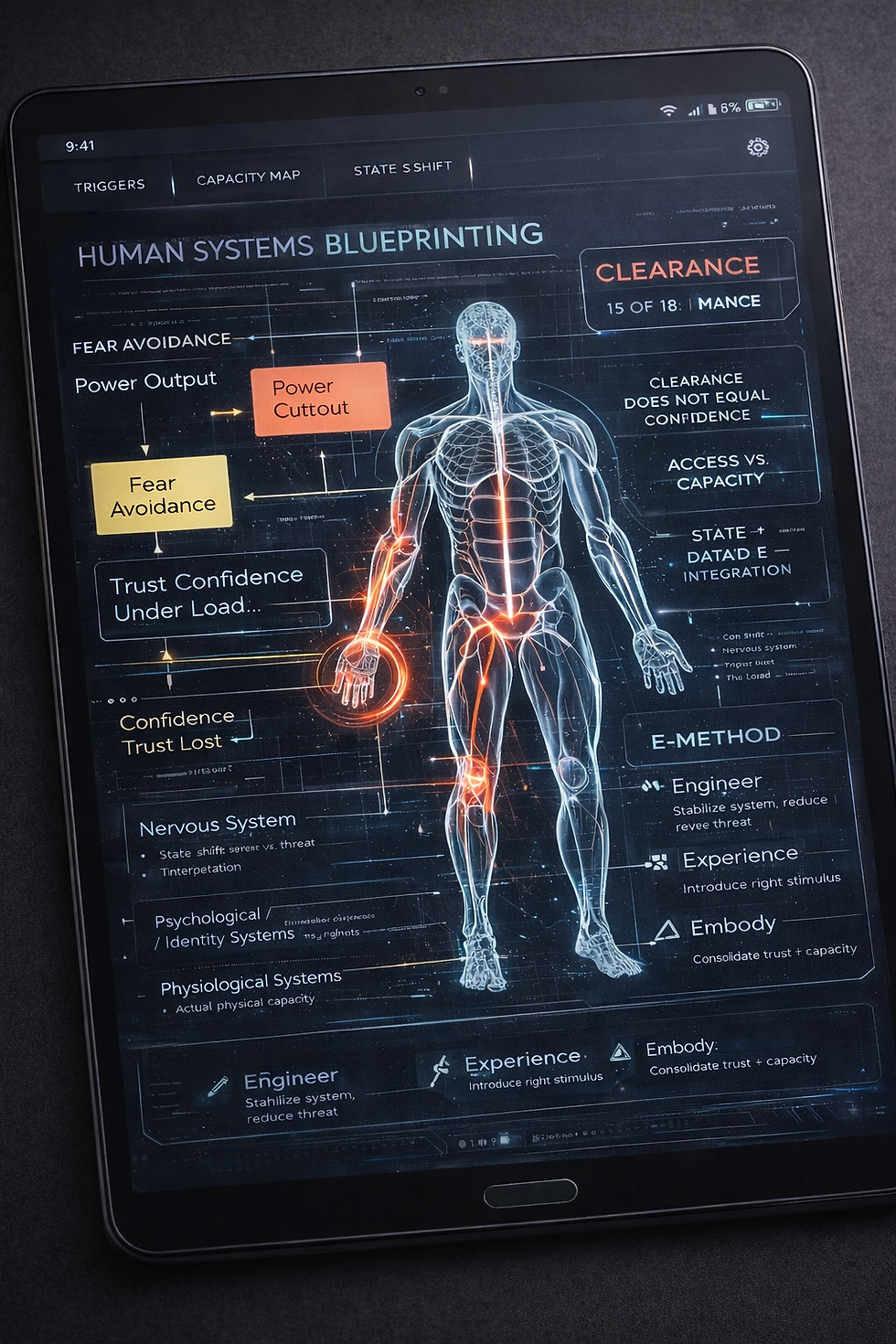
Èlysèen's Human Systems Blueprinting is about generating an encompassing set of data of the current state of the systems and integrating the right signals across the systems to ask more precise, consequential questions:
Where is access being gated right now?
Is the system organizing around protection or trust?
What intensity of change can be integrated in our session to initiate powerful change?
What sequence allows coherence to emerge rather than be forced?
Our blueprinting phase ultimately reveals what sequence of experience the system can trust.
Èlysèen's Human Systems Blueprinting synthesizes how information is gathered, interpreted, and applied across time as a living signal.
Rather than assessing systems independently, blueprinting integrates:
What is observable
What the system is demonstrating through posture, movement, rhythm , regulation, pacing, responsiveness, and voice intonation.
What is being experienced internally
The individual's lived sense of safety, effort, clarity, fatigue, confidence, resistance or readiness.
How meaning is being constructed
The language, narratives, tone, metaphors, and explanations the system uses to organize experience.
How the system responds to stimulus
What changes, and what does not- when load, novelty, intensity, or support is introduced.
What stabilizes vs destabilizes coherence
Which inputs increase integration, trust, and availability and which create protection, fragmentation, or withdrawal.
Ultimately the goal is to understand what is being revealed about the whole system. This system creates a dynamic map, on that updates as the system responds, rather than remaining fixed to a static assessment. Blueprinting is our way of creating dialogue between the human systems.
Energy and Soul as Organizing Forces
In Èlysèen’s Human Systems Blueprinting, energy and soul are not treated as abstract or spiritual concepts detached from the body. They are understood as organizing intelligence, fundamental forces that influence how the entire human system communicates, regulates, and expresses.
Energy refers to the availability, movement, and distribution of life force across the system.
The energy body and energy centres are subtly observed as an overarching layer throughout blueprinting.
When energy is constrained, the system compensates, often through over-efforting, protection, or fragmentation. When energy is coherent, capacity becomes usable with less force.
Soul refers to the individual’s core organizing truth, the intelligence that governs alignment, meaning, and resonance. It is reflected in:
whether effort feels clean or conflicted
whether expression feels authentic or distorted
whether decisions increase coherence or erosion over time
When the system is organized in alignment with this deeper truth, behavior becomes efficient, identity stabilizes, and coherence increases naturally. When it is not, the system adapts through protective strategies that may appear as resistance, burnout, or chronic tension.
Blueprinting does not work on energy or soul in isolation, it reads them integratively through the human systems.
Why This Matters Now- Especially in High Performance
High performance is no longer limited by knowledge, training quality, or access to tools. It is limited by signal clarity.
In environments of sustained pressure, complexity, and speed, the human system is constantly interpreting, filtering, and prioritizing information. What determines success is how clearly their system can access and express it without distortion.
This is why we now see:
highly trained athletes unable to reproduce performance under identical conditions
leaders with exceptional intelligence struggling with capacity, decision, and coherence
individuals who are naturally feel misaligned
These are not presented from a lack of discipline, motivation, or willpower- it is simply internal organization.
When internal systems lose clarity of communication, effort increases while effectiveness simultaneously declines. Performance becomes louder, heavier, and more forced- even while results still appear strong from the outside.
Blueprinting exists to address this moment. To restore clarity across the system so action can emerge cleanly. It reveals the conditions under which excellence becomes sustainable.
At its highest level, performance is about removing interference. When internal communication is clear, and access is granted on a systems level, an optimized internal and external world become the byproduct.
Closing Notes
Èlysèen's Human Systems Blueprinting is a way of seeing.
Seeing what is available.
Seeing what is constrained.
Seeing what comes next.
When you can see what is actually organizing beneath behavior, effort, and intention, the next step becomes an inviting path forward. And from that clarity, life, leadership, creativity, and performance begin to move with less resistance, and more alignment, freedom, and truth.
Comments